In power generation and most other utility plants, steam powered turbines are a critical component to plant functions. Maintaining high purity water and steam is critical to prevent corrosion and scaling on turbine blades and boiler components. Two important analytical concepts used in monitoring this purity are cation conductivity and specific conductivity. By comparing these two measurements, operators can distinguish between harmless variations and serious contamination events requiring immediate action.
Let’s begin by examining what distinguishes cation and specific conductivity and exploring the critical functions that they serve (and how we can help).
Cation and Specific Conductivity: What They Are and How They’re Used
Engineers use both specific and cation conductivity measurements to determine contaminant levels in high-purity streams such as boiler feedwater and steam condensate as these streams pass through boiler systems, turbines, and recycling systems, respectively. Ultimately, maintaining low conductivity levels in both specific and cation conductivity is essential for protecting turbine integrity and extending equipment life.
So what’s the difference? Specific conductivity measures the total conductivity of the sample exactly as it is. Meaning, the measurement covers the ionic activity of everything dissolved in the water. This includes both intentional additives, like ammonia or amines used for pH control, and unwanted contaminants, like chlorides, sulfates, or acids. This provides what can be considered an ambiguous measurement. Cation conductivity, on the other hand, removes that ambiguity.
Before measuring, the sample passes through a conditioning system followed by a cation exchange resin. This exchange resin replaces all positively charged ions, like sodium or ammonia, with negative, hydrogen ions. The exchange converts dissolved salts into their corresponding acids. Importantly, it removes the influence of alkalizing chemicals like ammonia, which are commonly present in power plant cycles and can lead to the type of corrosion and scaling operations are keen on avoiding.
Solutions for High Purity Water
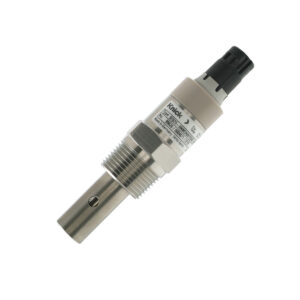
Utility infrastructure is only as reliable as the instrumentation that monitors it. M4 Knick’s high-purity solutions aid in bringing maximum accurate uptime to power generation facilities. For example, The SE625 is a Memosens coaxial conductivity sensor for high purity water or steam condensate applications. Excelling in accuracy in very low conductivity ranges, the SE625 is the ideal choice for detecting trace contamination in ultrapure boiler feedwater and condensate. This is extremely important for SWAS, where even trace contaminants can lead to corrosion and fouling within process infrastructure. The submersible inductive connection removes measurement influence from moisture and humidity, making it an ideal solution for high purity steam applications.
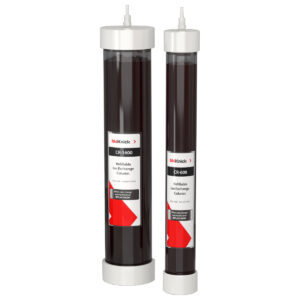
As proof of M4 Knick’s familiarity with high purity steam applications, we can also provide cationic exchange resin columns. These columns can be fitted into existing panels and have integrated retention filters on both the bottom and top of the device. Fully incorporated sample conditioning panels are also available.
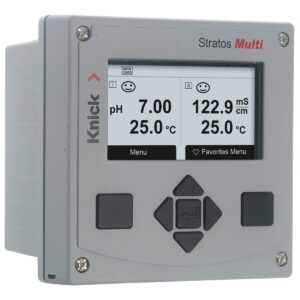
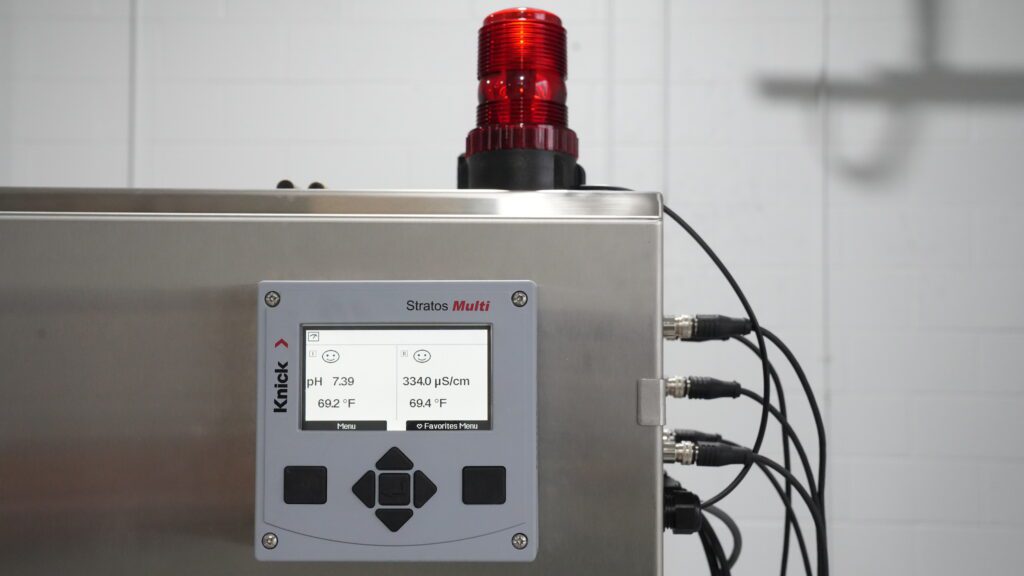
In order to maintain parameter visibility and real-time diagnostic information, The Stratos Multi transmitter is the ideal solution. The transmitter connects to Memosens® digital sensors along with analog or other digital sensors that can be connected simultaneously and in any combination. pH and conductivity can be measured simultaneously via one single transmitter. In addition to the sensor diagnostic system that monitors sensor health, the transmitter can trigger external alarms to warn operators of any measurement deviations.
Improving Accuracy and Reliability with M4 Knick
Cation and specific conductivity are critical measurements that prevent contamination, corrosion, and system inefficiencies. Therefore, their reliability is critical to plant safety and performance. However, without proper sample conditioning, high temperatures and pressures can compromise both sensor function and data accuracy. By integrating robust sample conditioning systems and accurate, reliable sensors, operators ensure that the process media remains under optimal conditions.For more information on M4 Knick’s solutions, reach out to one of our experts.
For a more hands-on experience with our innovative technology, consider scheduling a training. We’re committed to finding the best solution for anyone working on the process line, no matter the application.